X-T · 2017 · discontinued
Fujifilm X-T20 review
Launch price 899 USD · 24.3 MP X-Trans III sensor · 4K 30p video
Also written XT20 or X T20.

Compact X-T-line option before the X-T30.
Verdict
Discontinued X-T-line body with a 24.3 MP X-Trans III sensor and 4K/30p. Predecessor to the X-T30, 383g, tilting touchscreen, no IBIS, single UHS-I slot. Used market is where this lives now.
Budget buyers on the used market who want an X-T-style body with 4K video.
In detail
I used to shoot with an X-T20 and liked it, so let's talk about why it still matters in 2026.
The X-Trans III sensor is older, 24.3 MP on APS-C, paired with X-Processor Pro. Native ISO runs 200 to 12800, the AF is the older 325-point system with no subject detection, and burst is 8 fps. None of that is exciting by 2026 standards, but the files are honestly gorgeous. Fuji's color science was already excellent back then, and you still get film simulations done right.
On the video side you get 4K 30p in H.264, no log profile, but it does the job for casual clips and travel. Nothing more.
Build is the typical Fuji fit and finish, light, plastic-heavy in places, no weather sealing. No in-body stabilization, so stabilized XF glass is your friend. At 383g it lives in a small sling without complaint.
Battery is 350 shots CIPA, single UHS-I slot, NP-W126S. Bottom line: the used market is where this camera makes sense now, and you can find good ones for a fraction of launch price.
Pros and cons
What we like
- 24MP X-Trans III sensor at 383g
- 4K/30p video still usable
- Tilting touchscreen on a small body
- Compact X-T-style design
The headline win is value. 24MP X-Trans III at 383g for a few hundred dollars used is honestly great. Film simulation count is 5, the older lineup, but PROVIA, Velvia, ASTIA, Classic Chrome, and ACROS cover everything you actually need. 4K 30p is plenty for casual work, and the Fuji film simulations translate to video just as well.
Trade-offs
- Discontinued, no in-body stabilization
- Single SD UHS-I slot, not weather sealed
The honest trade-off is the AF. 325 points with no subject detection means it works for portraits and slow subjects but lags behind anything AI-driven for action. No in-body stabilization means a stabilized zoom or a faster shutter in low light. The XF 18-55mm kit zoom, the 16-80mm f/4 and the 50-140mm f/2.8 have OIS; the fast primes do not, so with a 23mm or 35mm on the front shutter speed is your only lever. The EVF at 2.36 million dots is dated. The tilting LCD is great for waist-level stills but doesn't flip forward for vlogging. Single card slot, fine until it isn't. Also, no longer supported, so no firmware love coming.
Who is this for
Budget buyers on the used market who want an X-T-style body with 4K video. Travel and everyday shooters will be happy. As a second body for someone already in the Fuji system, it is a real bargain. Just don't expect it to keep up with the AI AF of newer bodies.
Is the X-T20 still worth buying in 2026?
The X-T20 is the best value in used Fujifilm, and it has been for years. It has the same 24.3 MP X-Trans III sensor as the X-T2 and the X-Pro2, 8 fps, 4K video, and a tilting touchscreen, in a 383 gram body that costs less than most of the lenses you would put on it.
That is the argument and it is a strong one. If you are buying into X mount and you would rather put the money into glass, this body will not hold you back for a long time. The sensor is the same one Fujifilm was selling in flagships the same year, and sensor generation is what mostly decides how the files look.
What you give up is the professional shell around it. There is no weather sealing. There is one SD slot and it is the slower UHS-I kind. There is no in-body stabilization. Battery life is short enough that you will want a second one in your pocket. Autofocus is competent in daylight and it slows down as the light goes.
The X-T30 is the next step and it is a real one, mostly for a better autofocus system and a focus joystick. The X-S10 is the one to look at if stabilization matters, because it has it and the X-T20 never will. Buy the X-T20 when the budget is tight and you want the money in a 35mm f/2 instead.
X-T20 release date and lifecycle
The Fujifilm X-T20 was announced in January 2017. It was replaced by the X-T30.
Announcement month is from Fujifilm’s launch announcement; the on-sale month is not recorded for this body. Launch price is MSRP at release, not a used-market price.
Full specifications
| Release year | 2017 |
|---|---|
| Launch price | 899 USD |
| Status | Discontinued |
| Megapixels | 24.3 MP |
| Sensor generation | X-Trans III |
| Processor | X-Processor Pro |
| ISO range | 200–12800 |
| AF points | 325 |
| Subject detection | none |
| Burst (fps) | 8 |
| Max video | 4K 30p |
| Codec | H.264 |
| Log profile | No |
| Stabilization | None |
| Viewfinder | EVF (2.36M dot) |
| LCD | 3" tilt touch |
| Weather sealed | No |
| Weight | 383g |
| Card slots | 1 |
| Card types | SD UHS-I |
| Battery | NP-W126S |
| Battery life (CIPA) | 350 shots |
| Film sims | 5 |
Highlighted rows are class-leading within the current Fujifilm APS-C lineup.
Film simulations (5)
- PROVIA
- Velvia
- ASTIA
- Classic Chrome
- ACROS
Compared with


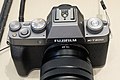
Fujifilm X-T20 vs siblings
How the X-T20 stacks up against the closest siblings in the current Fujifilm lineup.
Fujifilm X-T20 vs X-T30 III
The Fujifilm X-T20 and Fujifilm X-T30 III are both Fujifilm X-T bodies. The X-T30 III is the newer of the two, arriving in 2025. At launch the X-T20 was 899 USD and the X-T30 III 999 USD, making the X-T20 the more affordable of the two.
Fujifilm X-T20 vs X-T50
The Fujifilm X-T20 and Fujifilm X-T50 are both Fujifilm X-T bodies. The X-T50 is the newer of the two, arriving in 2024. At launch the X-T20 was 899 USD and the X-T50 1,399 USD, making the X-T20 the more affordable of the two.
Fujifilm X-T20 vs X-T5
The Fujifilm X-T20 and Fujifilm X-T5 are both Fujifilm X-T bodies. The X-T5 is the newer of the two, arriving in 2022. At launch the X-T20 was 899 USD and the X-T5 1,699 USD, making the X-T20 the more affordable of the two.
Where to buy
The link below runs an Amazon search for this camera rather than pointing at one listing, because stock and sellers move around. As an Amazon Associate we earn from qualifying purchases — at no extra cost to you.

See it in the wild
Owner impressions and real-world photos from the Fuji community.

